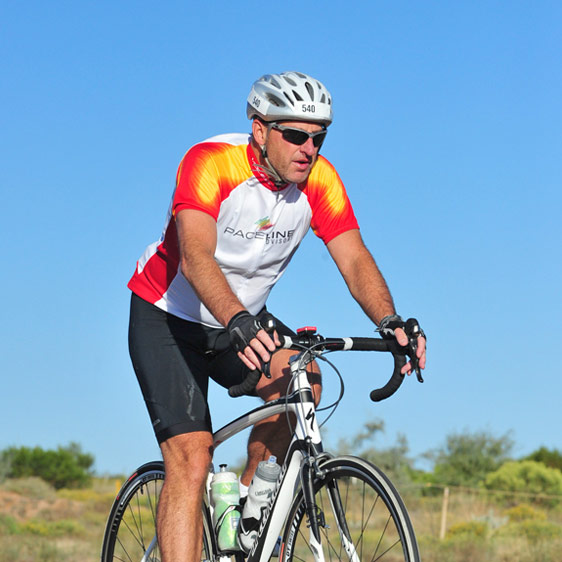
Robert Nutt says he is retired, but his daily planner paints another picture. As president and managing director of Paceline Advisors, a strategic business and financial consulting firm Nutt created after 30 years in corporate finance and operations, he travels constantly and volunteers for three organizations and businesses. His hectic schedule does not leave much time for relaxation, let alone skiing, bicycling and running marathons. In fact, a bicycling accident during a training ride in Scottsdale, Arizona, almost ended Nutt’s ability to participate in any recreational activities.
According to Nutt, he was about 40 miles from the start when another rider accidently clipped his back tire causing him to fall. “It happened so quickly I was on the ground before I knew what happened and my left knee took the brunt of my fall,” Nutt explained. Unable to finish the ride, he was taken to the emergency room where doctors gave him the bad news. “I tore my medial collateral and posterior cruciate and anterior cruciate ligaments (MCL, PCL, ACL), as well as my meniscus,” he said. “They put a brace on my knee to stabilize it and I flew home to Darien, Illinois, uncertain if I’d ever be able to race again, let alone be able to ride a bike,” Nutt said.
To allow his knee swelling to subside, Nutt started a conservative physical therapy under the care of an orthopaedic surgeon at Hinsdale Orthopaedics in Hinsdale, Illinois, before being referred to the practice’s arthroscopic shoulder and knee specialist and a US News & World Report Top Doctor in orthopaedics, Dr. Steven Chudik.
“As a Type A personality, I’m not one to sit so I wanted to proceed with surgery as soon as Dr. Chudik explained that was the only solution for me to have even a chance of running or biking again,” Nutt said. “I learned later that Dr. Chudik told my wife after my surgery he’d be surprised if I’d ever be able to run more than 10 miles at one time because of the extensive damage he repaired during my five hour operation. She told him not to tell me that and I’m glad neither did,” Nutt laughed.
“Robert tore nearly every ligament in his knee,” Dr. Chudik explained. “It was a terrible injury. His recovery is a testament to his determination and commitment to completing his rehabilitation program and returning to his active lifestyle,” he added.
Following five weeks in a brace, six months of physical therapy three times per week and home exercises every day, Dr. Chudik cleared Nutt to resume his activities limiting his bike riding to just one to two miles per day to start. According to Nutt, that did not last long. “I regularly ride a couple hundred miles a week, and was anxious to get back to running and biking. My come back goal was the Mercedes Benz Marathon in Alabama and to participate in RAGBRAI (Register’s Annual Great Bike Ride Across Iowa),” he said. RAGBRAI is the longest, largest and oldest annual bicycle-touring event started in 1973 as a friendly challenge between two Des Moines Register newspaper employees. According to the Register’s event information, the annual, seven-day ride averages nearly 500 miles beginning with a traditional dipping of riders’ back tires in the Missouri River and ending with the dunking of their front tires in the Mississippi River.
Today, Nutt annually competes in several marathons a year, RAGBRAI and downhill skis without hesitation or reservation. “I’m very grateful to Dr. Chudik for giving me back my active lifestyle. I can’t imagine what I’d be doing if it were not for him,” Nutt said.